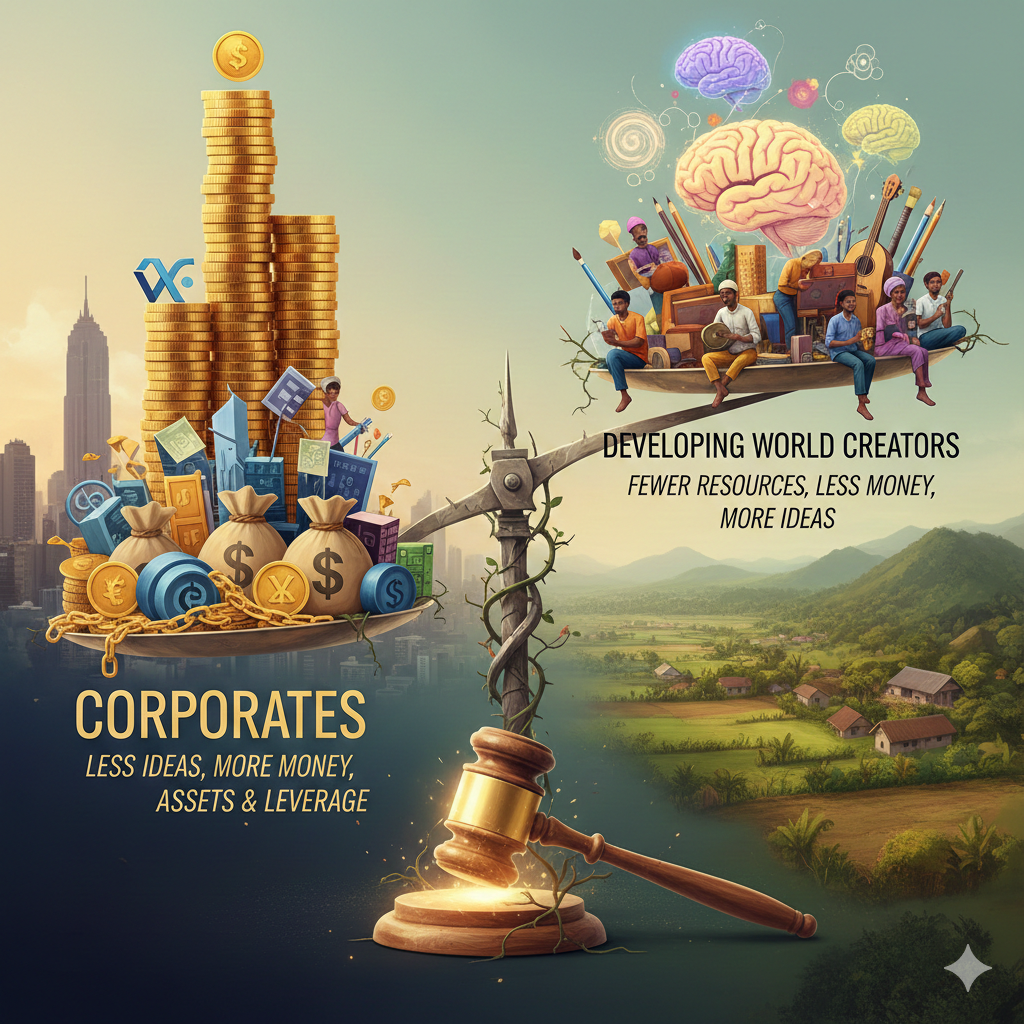
Across much of the developing world, the greatest barrier to innovation is not a lack of creativity or technical imagination, but an intellectual property landscape that remains structurally imbalanced. Over the past decade, the global technology ecosystem has shifted in ways that unintentionally marginalise emerging‑market innovators.
A decade ago, open innovation models were far more common. Around 2014 and earlier, many companies actively engaged with ideas from the public, sometimes even from independent bloggers and freelance communities. Platforms such as MyNokiaBlog demonstrated that external contributions could meaningfully influence corporate attention and product thinking.
Today, however, the environment has changed dramatically. Many major technology companies have adopted strict unsolicited‑idea submission policies, effectively preventing innovators from sharing concepts unless they are already within formal networks or employment pipelines. At the same time, opportunities such as global contests, conferences, fellowships, and grants increasingly require formal degree qualifications as entry criteria.
This shift disproportionately excludes innovators from developing regions, where academic pathways are often disrupted by poverty, conflict, statelessness, limited educational infrastructure, or forced career trajectories. As a result, a significant pool of talent is systematically filtered out before their ideas can even be considered.
Compounding this challenge, IP systems in many developing countries remain prohibitively expensive and difficult to navigate. Consultancy fees are high, public awareness is low, and the processes themselves are often inaccessible. These barriers prevent innovators from protecting or operationalising their ideas, even when their intention is not commercial gain but social impact. The global community continues to struggle with solvable problems partly because low‑cost, transparent, and accessible IP pathways are still not widely available.
The consequences are visible across sectors. For example, promising concepts in areas such as GPS usability and human‑technology interaction cannot be shared with dominant market players because leading platforms, such as major mapping services, do not accept external idea submissions. This dynamic reinforces a closed innovation loop that excludes voices from regions where technological creativity is abundant but structurally unsupported.
There is a growing need for regulators, policymakers, and global institutions to re‑examine how innovation ecosystems can become more inclusive. A fairer, more accessible IP environment, paired with open, merit‑based pathways for idea consideration, would unlock significant untapped potential and contribute to solving global challenges with solutions that already exist but lack a route to recognition.


